
- New Arrivals
- All Quilting Cotton Fabrics
- Cotton Fabric Collections
- Plain Cotton Solids
- Basics and Blender Fabrics
- Fabric Pre-Cuts and Bundles
- Fabric Panels
- Cotton Border Prints
- Licensed Quilting Fabrics
- Landscape Quilting Fabrics
- Cotton Poplin Fabrics
- Polycotton Fabrics
- Cotton Flannel Fabrics
- Christmas Quilting Fabrics & Panels
- Metallic Cotton Fabrics
- Anna Maria Textiles
- 3 Wishes Fabric
- Craft Cotton Company
- Camelot Fabrics
- Clothworks
- Dashwood Studio
- Dan Morris
- Debbie Shore
- Fabric Freedom
- Free Spirit
- Figo Fabrics
- Hannah Dale - Wrendale Designs
- Henry Glass
- In the Beginning Fabrics
- Jason Yenter
- Liberty Fabric
- Lori Holt
- Make + Believe
- Makower UK
- Maywood Studio
- Moda Fabrics
- Northcott Fabrics
- Quilting Treasures
- Riley Blake
- Robert Kaufman
- The Crafty Pie
- Tula Pink Fabrics
- William Morris by V & A
- Floral Quilting Fabric
- Botanical and Leaf
- Ditsy Print Fabric
- Stripes, Checks and Plaids
- Spot Quilting Fabric
- Modern and Geometric Fabric
- Animal and Wildlife
- Childrens, Baby and Nursery
- Fantasy and Fairytale
- Novelty Quilting Fabric
- Damask and Toile Quilting Fabric
- Home & Farmhouse
- Tone on Tone
- Easter and Spring
- Christmas Fabric
- Halloween Fabric
- Autumn & Harvest
- Nautical and Coastal
- Animal Print
- Gothic and Skulls

- New Arrivals
- All Dressmaking Fabrics
- Cotton Lawn
- Cotton Poplin and Shirting
- Dressmaking Cotton
- Viscose and Tencel
- Cotton Jersey
- Viscose Jersey
- French Terry
- Sweatshirt Fabric
- Ribbing and Cuffing
- Denim and Chambray
- Wool, Wool Blends and Boucle
- Linen and Linen Blends
- Double Gauze and Seersucker
- Broderie Anglaise and Lace
- Corduroy
- Polycotton
- Polyester
- Twill and Drill
- Gingham, Tartan and Check
- Velvet and Velour
- Faux Silk and Silk
- Sequin and Embellished Fabric
- Chiffon and Georgette
- Anti-Static Lining
- Calico, Muslin and Hessian
- Dress Net
- Crepe and Satin
- Towelling Fabric
- All Dressmaking Tools
- Machine Needles
- Straight Pins
- Thread
- Zips
- Elastic
- Interfacing and Stabilisers
- Marking and Tracing Tools
- Rulers and Measuring Tools
- Cutting Tools
- Buttons
- Self Cover Buttons
- Bias Binding
- Ribbon, Trim and Elastic
- Fastenings and Hardware
- Hemming and Fusing
- Snips and Rippers
- Pattern Weights
- Sewing Patterns
- Dressmaking Patterns

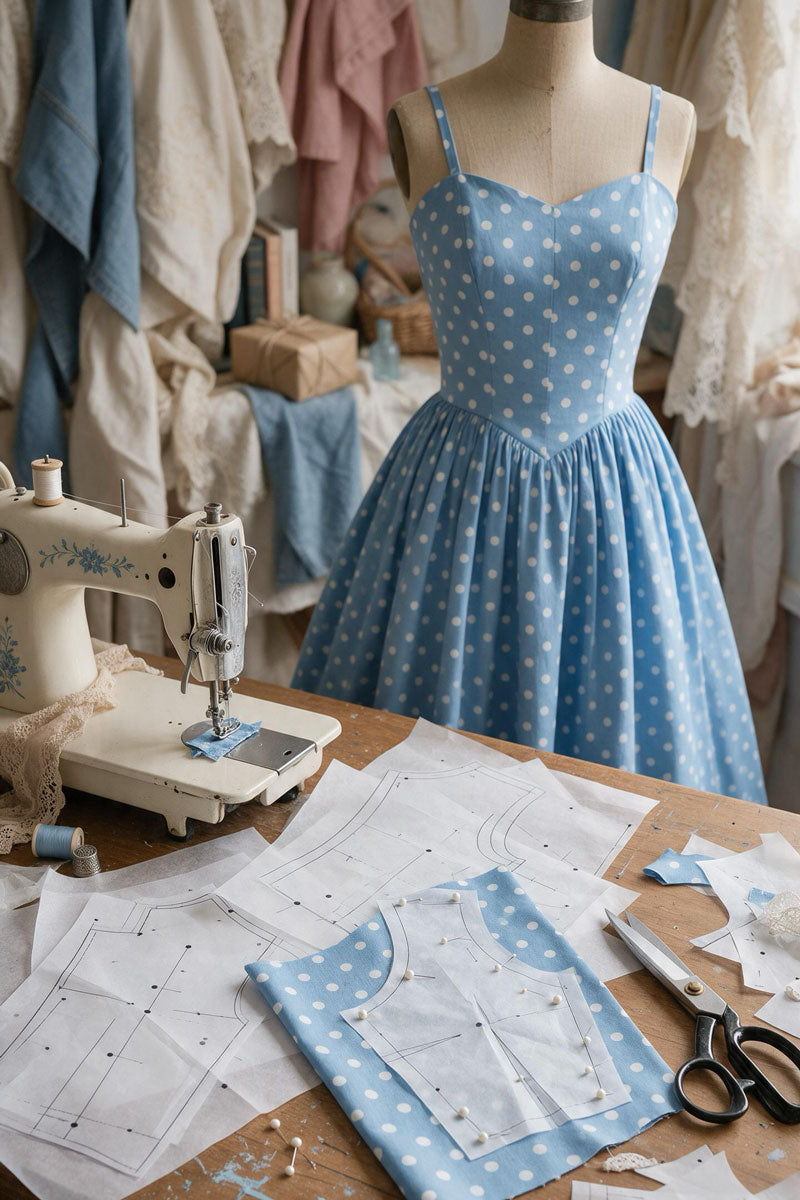

Dressmaking and Sewing Calculators
Dressmaking & Sewing Calculators
Enter your own measurements for an accurate fabric requirement — no guessing from dress sizes. All calculators work in both centimetres and inches.
Fabric By Garment Calculator
Enter your actual measurements for the most accurate fabric estimate. Use the measuring guide below to take your measurements correctly. All calculations include ease and seam allowances.
How To Take Your Measurements
Enter your actual body measurements — the calculator adds all ease and seam allowances automatically.
1. Bust or hips — measure the fullest part
2. Hips — measure the widest part (could be thighs)
3. Sleeve length — shoulder to wrist
4. Body length — front neck to finished hem (for dresses)
5. Body length — base of neck to finished length (for tops)
6. Waist to hem (for skirts)
7. Waist to finished length (for trousers)
These are estimates. Always check your pattern envelope for exact requirements. The calculations follow standard dressmaking rules — on narrow fabric (110–115cm) trousers require two separate leg lengths as the fabric is not wide enough to cut both legs side by side.
Bias & Straight Cut Binding Fabric Calculator
Work out how much fabric you need to make your own binding — whether you are cutting on the straight grain or on the bias. Useful for garments with bound edges such as necklines, armholes, hems and seams.
Cut strip width is the width you cut before folding. A typical dressmaking binding uses a 3.8cm (1½ inch) cut strip which gives approximately 1cm finished binding. For wider binding use 5cm (2 inch) cut strips.
Straight cut binding is cut across the full width of the fabric. Works well for straight edges and uses less fabric.
Bias cut binding is cut at a 45° angle. More stretch — ideal for curved necklines, armholes and curved hems. Requires approximately 30% more fabric due to diagonal waste.
Straight cut binding is cut across the full width of the fabric. Works well for straight edges and uses less fabric.
Bias cut binding is cut at a 45° angle. More stretch — ideal for curved necklines, armholes and curved hems. Requires approximately 30% more fabric due to diagonal waste.
Ease Calculator
Ease is the extra room built into a garment so you can move comfortably. Without ease a garment would be impossible to wear. The amount depends on the garment style and the fabric type — stretch fabrics need less ease because the fabric itself provides the give.
What is ease? If your bust measures 92cm and your garment measures 97cm at the bust, the ease is 5cm. This extra space is what allows you to breathe, sit and raise your arms.
Stretch fabrics need less ease because the fabric itself gives. A close-fit top in jersey may have negative ease — it is actually smaller than your measurements — because the stretch provides the room needed.
Stretch fabrics need less ease because the fabric itself gives. A close-fit top in jersey may have negative ease — it is actually smaller than your measurements — because the stretch provides the room needed.
Hem Allowance Calculator
A hem allowance is the extra fabric added to the bottom of a garment so it can be folded up and stitched to create a neat finished edge. This calculator works out the total cut length you need to achieve your desired finished length.
Which hem type should I choose?
A double fold hem is the most common — fold the raw edge up once, then fold again to enclose it, then stitch. Neat and durable.
A narrow hem is best for lightweight or sheer fabrics where a deeper hem would show through.
A rolled hem is ideal for silk, chiffon and delicate fabrics — gives a very fine professional finish.
A blind hem is almost invisible from the right side — ideal for smart trousers and skirts.
Zip Length Guide
Find the right zip length for your project. Zip lengths refer to the length of the teeth, not the overall zip tape. Always buy a zip slightly longer than you need — you can shorten a zip but you cannot lengthen one.
| Garment / Project | Zip Type | Recommended Length | Notes |
|---|---|---|---|
| Dress — Back Zip | Invisible Or Concealed | 55–60cm | Measure from neckline to below the waist |
| Dress — Side Zip | Invisible | 20–25cm | From underarm to hip level |
| Skirt — Back Zip | Invisible Or Concealed | 20–25cm | From waistband into the skirt |
| Skirt — Side Zip | Invisible | 18–22cm | From waistband to hip level |
| Trousers — Front Fly | Jeans Zip | 15–18cm | Standard fly opening |
| Jacket — Front | Open-Ended Zip | 55–65cm | Measure from hem to collar |
| Coat — Front | Open-Ended Zip | 65–80cm | Measure the full opening length |
| Hoodie — Front | Open-Ended Zip | 50–60cm | Measure from hem to collar |
| Cushion Cover | Nylon Coil | 40–50cm | Allow 5cm shorter than the opening |
| Bag — Top Opening | Nylon Coil | 30–40cm | 2–3cm shorter than the bag width |
| Pouch / Purse | Nylon Coil | 15–20cm | Match to the opening width |
Invisible zips are sewn so the zip is hidden in the seam — only the pull tab is visible. They require a special invisible zip foot.
Open-ended zips separate completely at the bottom — essential for jackets and coats.
Nylon coil zips are lightweight and flexible — ideal for bags, cushions and lightweight garments.
Open-ended zips separate completely at the bottom — essential for jackets and coats.
Nylon coil zips are lightweight and flexible — ideal for bags, cushions and lightweight garments.
Seam Allowance Converter
A seam allowance is the extra fabric between the cut edge and the stitching line. It stops the seam from fraying. This calculator works out the finished size after sewing, or how large you need to cut a piece to achieve a specific finished size.
Dressmaking uses 1.5cm seam allowances as standard — this gives enough room to press the seam open neatly and to let out the seam if you need to adjust the fit. Quilting uses 6mm (¼ inch). Always check your pattern for the seam allowance it uses before you start cutting.